essay — 22.05.2026
The Ghost Record: GucciCore, verxx33, and the Censored Mutation
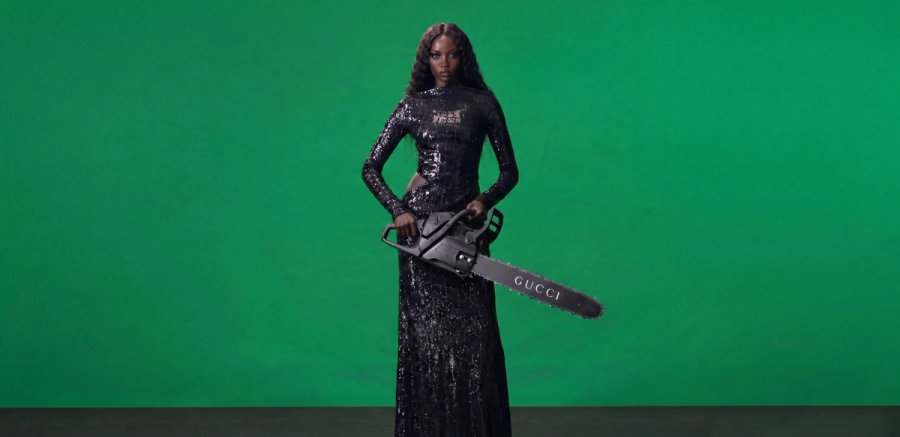
In the volatile landscape where digital creativity collides with corporate authority, some visions are too potent to be contained. verxx33’s digital mutation of Demna’s GucciCore runway; a raw, visceral reinterpretation,recently faced the ultimate corporate defense mechanism: a trademark complaint from Gucci, leading to the swift removal of the original post. WANC Journal records this not as a defeat, but as a definitive moment: the birth of a Ghost Record.
This incident elevates Verxx33’s work from a mere creative interpretation to a strategic statement on the future of intellectual property in the digital age. As verxx33 himself notes, "The uncanny feeling appears when something feels believable while remaining physically impossible at the same time." This tension, amplified by corporate reaction, proves that some mutations are so real, so resonant, that they challenge the very fabric of brand control. Here, we deconstruct the layers of this censored vision, affirming its place in the digital archive.
The Structural Codes of a Censored Vision
01 — The Unofficial Mutation: A Vision Beyond Control
Verxx33’s reinterpretation of GucciCore was never an official collaboration; it was an inspired act of digital alchemy. By taking Demna’s Times Square spectacle, a commentary on camouflage and urban anonymity, and pushing it into a realm of liquid metal fabrics, digital winds, and AI-breathed tactical gear, Verxx33 created a parallel reality. This was a Material Intelligence at play, where the digital artist didn't just observe, but actively mutated the brand’s narrative. The resulting vision, in WANC Journal’s view, carried a more powerful and current resonance than Gucci’s official campaigns, precisely because it was unburdened by corporate directives.
02 — The Vision Dialogue: Verxx33 on the Ghost Record
In an exclusive dialogue with WANC Journal, Verxx33 sheds light on the creative process behind the GucciCore mutation and the implications of its subsequent removal:
The Trigger of Mutation:
"For me, the trigger wasn’t only fashion itself, but the atmosphere of contemporary culture as a whole. Tactical aesthetics are no longer limited to military environments. They’ve become part of modern visual language and started appearing across fashion, music and digital culture. What attracted me was the contrast between luxury aesthetics and tactical elements. I wanted to combine these things and push that feeling into a new visual form."
Material Intelligence in Flux:
"Once fashion moves into a digital environment, materials begin to be perceived completely differently. AI removes physical limitations and allows the creation of visual forms that would be impossible to realize in reality. For me, digital materiality is no longer just about simulating fabric, but about creating a new way of perceiving form, texture and the visual feeling of an object itself."
The Unofficial Power:
"Independent work gives more freedom because you’re not operating inside institutional limitations. You can work more instinctively, experiment more freely and avoid constantly thinking about restrictions. A visual artist can’t exist inside only one direction. To create strong projects, you need to understand fashion, music, trends and how all of these things influence each other. That’s where the real understanding of aesthetics comes from, how to combine different elements and build projects that feel cohesive and natural."
Digital Uncanny:
"I’m not trying to make digital imagery look perfectly realistic. I think reality itself is already becoming increasingly artificial. The uncanny feeling appears when something feels believable while remaining physically impossible at the same time. That tension between digital imagery and human perception is what interests me the most."
Reconstructing the Archive:
"I think AI is changing the entire approach to visual culture and fashion archives. They are no longer static objects. Any visual material can now be reinterpreted, reconstructed and transformed into something new. For me, the role of a digital artist is not to repeat existing things, but to pass them through your own perception and turn them into something different. AI simply made this process faster, freer and without the previous limitations."
03 — Corporate Defense: The Trademark as a Weapon
Gucci’s response, a direct trademark complaint to Instagram, bypassing any dialogue with the artist, reveals a fundamental tension. In an era where digital artists fluidly remix and reinterpret cultural artifacts, traditional intellectual property frameworks often become tools of suppression rather than protection. This wasn't a creative critique; it was a legal maneuver to erase a narrative that, perhaps, felt too close to the bone, too uncontrolled. The trademark complaint serves as a stark reminder of the corporate fear of Digital Anarchy, where brand identity can be re-coded by external forces.
04 — The Ghost Record: Living in the Digital Uncanny
Despite its removal, verxx33’s GucciCore mutation now exists as a Ghost Record. It is a vision that, once seen, cannot be unseen. Its absence on official platforms only amplifies its presence in the collective digital memory. This is the essence of the Digital Uncanny: a familiar entity (Gucci) rendered strange and unsettling by its digital mutation. WANC Journal asserts that true cultural impact is not always measured by official endorsement, but by its ability to provoke, to mutate, and to persist in the face of corporate erasure.
05 — The Strategic Imperative: WANC Journal as Archivist of the Unseen
For WANC Journal, this incident underscores our strategic imperative: to be the archivist of the unseen, the chronicler of cultural mutations that challenge the status quo. Verxx33’s work, now a Censored Mutation, becomes a critical case study in the ongoing battle for creative autonomy in the digital sphere. We believe this vision must live on, not just as art, but as a record of the friction between established power and emergent digital intelligence.
The Strategic Record: A Manifesto for Digital Rebellion
The GucciCore mutation by Verxx33, though removed, stands as a testament to the power of independent digital vision. It is a Ghost Record that speaks volumes about the fragility of corporate control in the face of genuine creative force. As Verxx33 articulates, "AI simply made this process faster, freer and without the previous limitations," underscoring the artist's role not just as a creator, but as an active mutator of cultural narratives. WANC Journal proudly registers this work as a vital piece of Intellectual Capital, a blueprint for understanding the future where digital artists are not just creators, but active mutators of cultural narratives. The future is not just created; it is re-coded, even when it’s censored.
Sonraki Yazı
The Interstellar Frontier: Vollebak, SAGA, and the Planetary Protocol
Okumaya Devam Et
essay